


Highlights
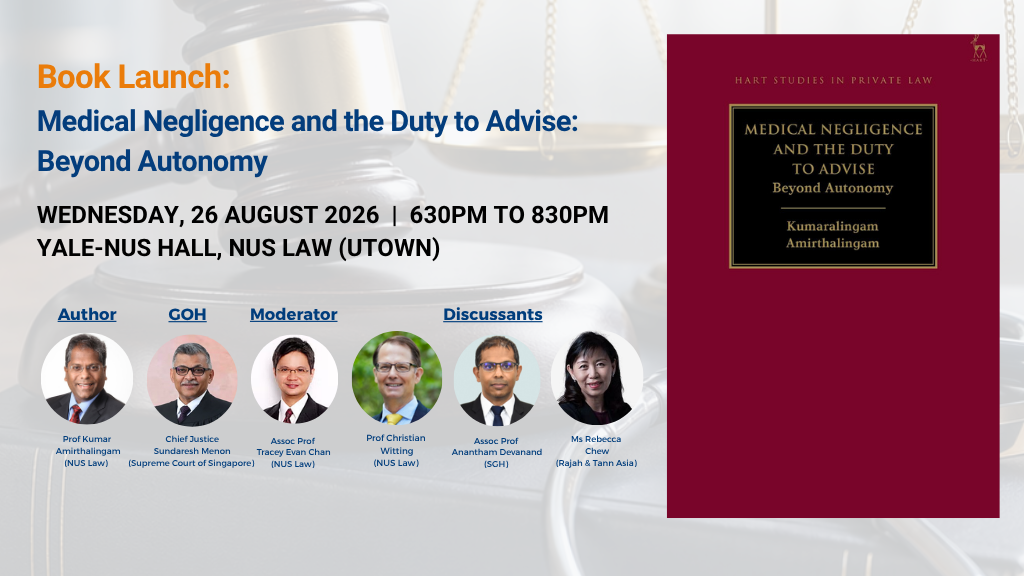
[Book Launch] Medical Negligence and the Duty to Advise: Beyond Autonomy
This book argues that the emphasis on autonomy has distorted orthodox negligence principles, contributing to uncertainty and angst amongst healthcare professionals while eroding trust in the doctor-patient relationship. This work takes the current discourse beyond autonomy – which focuses on the rights of the patient, to agency and shared decision-making – which focus on the relationship between doctor and patient. Provocatively, this work argues against an individualistic, rights-based approach to negligence – which can be confrontational – in favour of a relational, human obligations approach. Drawing on the theoretical analysis, the book identifies doctrinal anomalies in the duty of care, standard of care, causation, and damage.
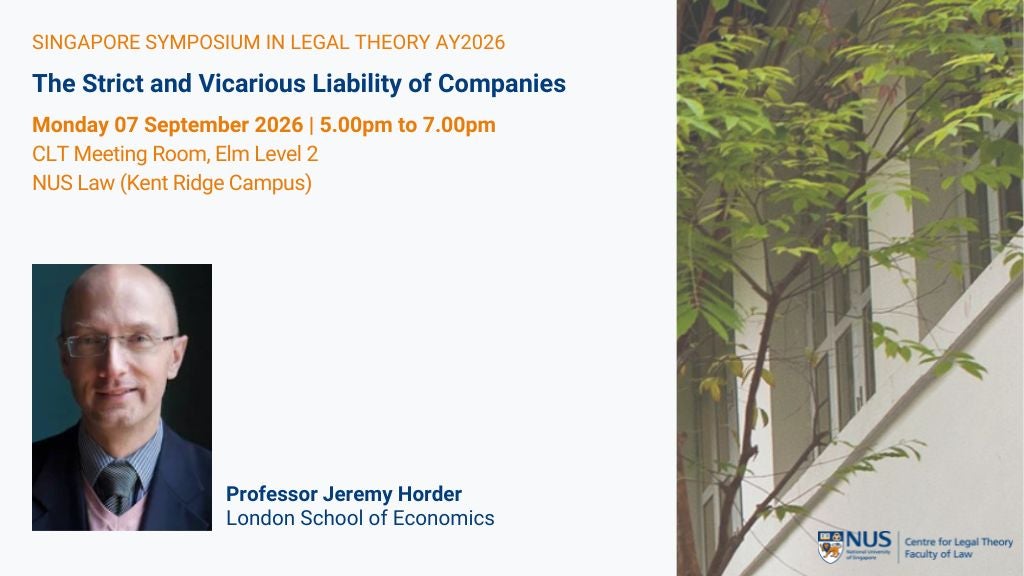
The Singapore Symposium in Legal Theory AY2026 “The Strict and Vicarious Liability of Companies” by Professor Jeremy Horder, London School of Economics
The history of criminal law scholarship is largely the history of the struggle to develop a more principled (and humane) approach to the criminalization of individuals; but in course of that struggle, the meaning and significance
of key criminal concepts, as well as the understanding of what is historically and morally significant about the criminal law, has come to be understood as almost wholly in individualized terms. In that regard, a larger project I have in mind will involve an argument that membership of the EU between 1972 and 2020 had a profound and far-reaching effect on criminalization in the UK that had gone largely unnoticed, because it affected mainly (small) companies, even though it had very real implications for the individuals running those companies.
The Singapore Symposium in Legal Theory AY2026 “Consenting, Promising, and the Power to Contract” by Dr Irina Sakharova, Durham University
In moral and legal philosophy, there are different approaches to understanding consent as a normative power. It might be fair to observe that when a reference to consent is made, consenting is often understood as giving permission, but consent as a normative power has been conceptualised in two (different) ways: as a ‘proprietary gate’ (eg giving a license) or as a ‘normative rope’ (eg assuming an obligation).


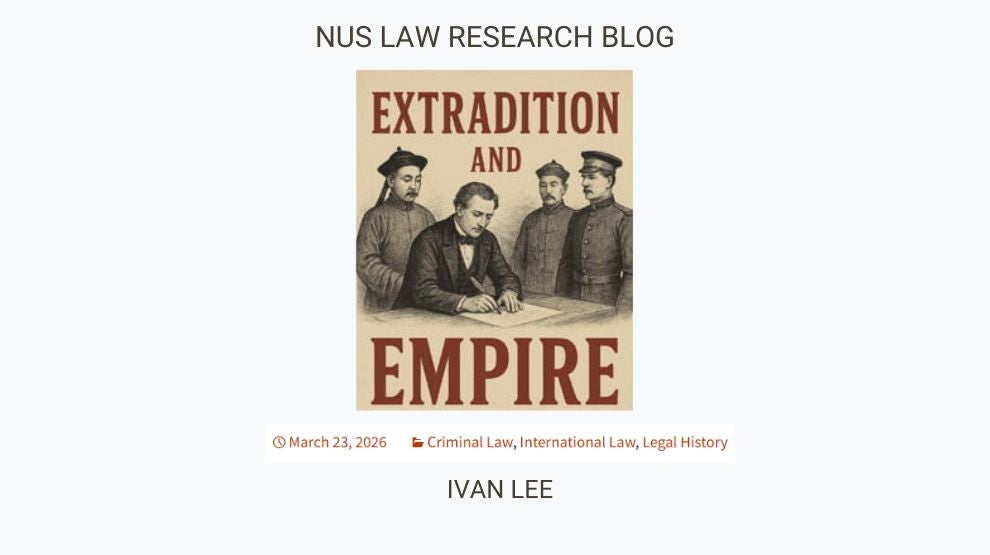
[BLOG] Extradition and Empire
Ivan Lee observed that contrary to later interpretations, the Opium War treaties (1842-43) did not explicitly establish extradition or extraterritoriality. Instead vague language was used about handing over criminals and punishing people under their own laws. Later scholars assumed these treaties created formal legal systems, but in reality, those systems were developed gradually over the following decades and early colonial Hong Kong was a testing ground where Britain slowly built rules about jurisdiction (who has legal authority over whom).